

Have you ever been so busy at work that you suddenly realize your mouth feels like a desert, your head is starting to throb, and your bladder has been unemployed since 7 AM?
Welcome to lab life, mga ka-medtech.
There are days in the clinical laboratory when drinking water feels like a luxury activity. Like spa day. Like vacation leave. Like a quiet phone call from the ER saying, “No worries, take your time.” Charot. That call does not exist in nature.
On a busy shift, it is so easy to forget water. One minute you are receiving specimens, the next you are loading samples, checking flags, answering calls, verifying results, hunting for that one missing tube, and wondering if the centrifuge is making its normal sound or its “I’m about to become a problem” sound.
Then suddenly it is afternoon, and your body sends a memo: Hoy. Tubig naman diyan.
The 2 PM Crash Is Not Always Coffee’s Fault
I used to blame everything on lack of coffee.
Feeling sleepy? Need coffee.
Feeling cranky? Need coffee.
Feeling like my soul left my body after a pile of pending samples? Definitely coffee.
But after a while, I noticed something. On days when I barely drank water, the afternoon shift felt heavier. My eyes felt dry. My head felt tight. My patience got thinner than a properly made blood smear. Even my thinking felt slower, which is not ideal when you are dealing with results that need accuracy, focus, and a brain that is not running on fumes.
And yes, coffee helps. Coffee is a trusted coworker. A lodi. But coffee cannot do all the emotional labor, mga bes.
Sometimes the “I’m exhausted” feeling is not deep burnout or drama. Sometimes it is your body whispering, “You have not had water since breakfast, genius.”
That realization hit me one afternoon while I was standing near my station, staring at my water bottle like it was an old friend I had betrayed. It was full. Full! As in, untouched since the start of my shift. Grabe. The bottle was more hydrated than me.
My Small Hydration Hack: Keep the Bottle Where You Can See It
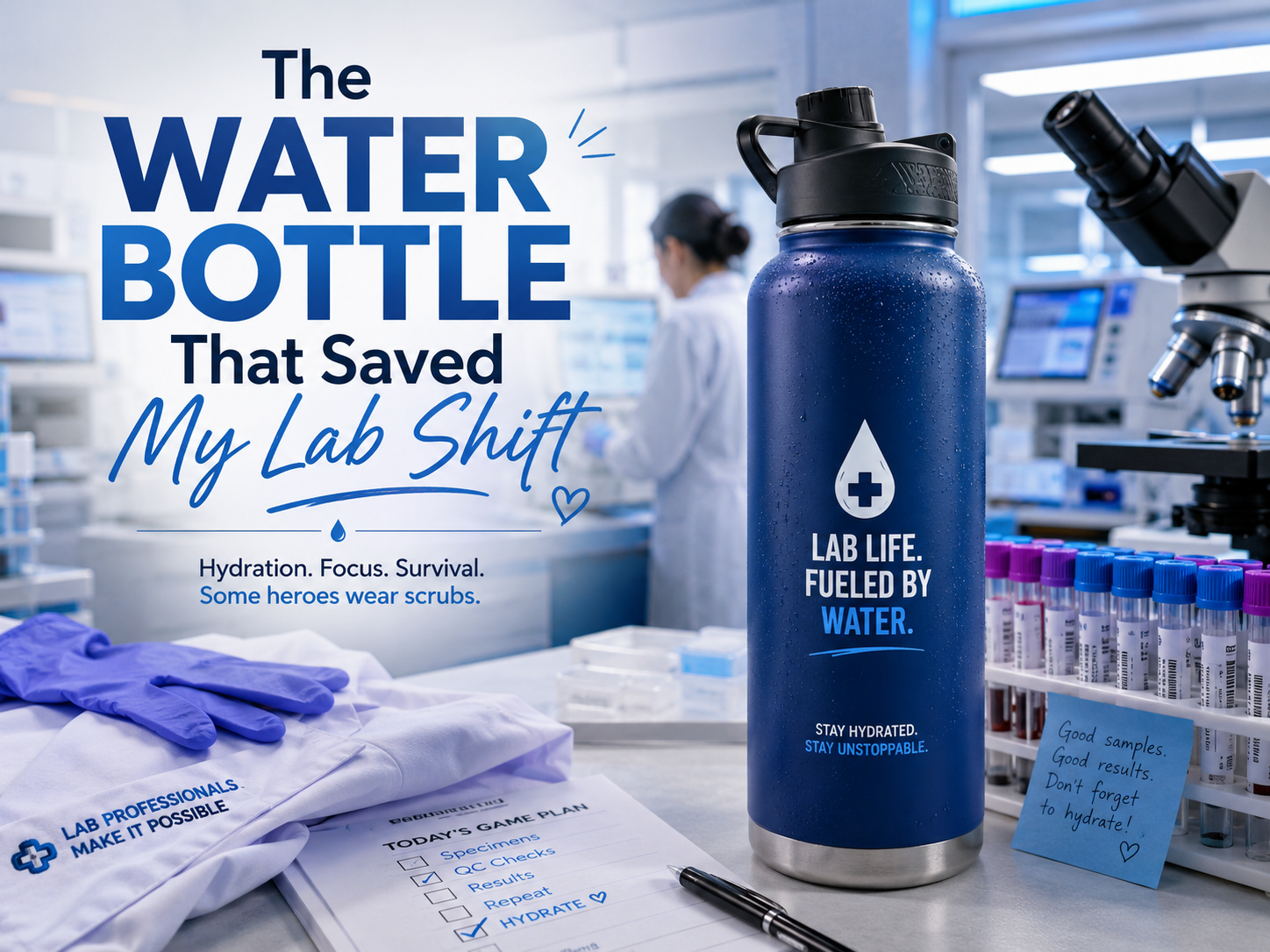
So I started doing one simple thing: I keep a water bottle at my station, somewhere visible and easy to reach.
Not hidden inside a bag. Not abandoned in the break room like a forgotten high school project. Not sitting somewhere I need to cross three kingdoms and one hallway to access.
Just there. Near me. Within sight.
Of course, we follow workplace rules. If your lab has strict policies about drinks in technical areas, please follow them. Safety first. We are not trying to hydrate with a side of contamination. In my case, I keep it in the allowed area near my work station, where I can grab a quick sip during natural breaks.
And honestly? It helped.
Not in a dramatic movie montage way where I suddenly became glowing and productive like a commercial for electrolyte water. Walang slow motion. Walang wind effect. But by afternoon, I could feel the difference.
I felt more awake. Less headache-y. Less like a dried mango left open in the pantry. My mood improved too, which is good for everyone involved, especially the printer that jams at the worst possible time.
The Lab Does Not Pause Just Because You Are Thirsty
One thing people outside healthcare do not always understand is that our breaks are not always neat and predictable.
In an ideal world, you clock in, do your tasks, drink water every hour, take your lunch on time, breathe deeply, maybe journal under a tree. Very aesthetic.
In the real lab world, the analyzer alarms, the phone rings, a stat sample arrives, someone asks about a result that is still incubating, and the specimen that should be straightforward suddenly becomes a mini detective case.
Before you know it, your “quick task” became two hours. Your lunch became a concept. Your water bottle became decor.
This is why I do not rely on memory anymore. My memory during a busy shift is already assigned to more important things, like critical values, sample IDs, QC issues, and whether I locked the fridge properly. Hydration cannot be another thing floating in the mental chaos.
So I make it obvious. I make it easy. I make it visible.
What Actually Works for Me During a Busy Shift
I am not a hydration guru. I am just a med tech trying not to become a raisin before endorsement. But these small habits have helped me, especially on busy days:
- Bring a bottle you actually like using. If the lid is annoying or it leaks, you will avoid it. Choose something easy to open and clean.
- Keep it in an allowed, visible spot. Out of sight, out of mind. And in lab life, out of mind means “see you after eight hours.”
- Take small sips during natural pauses. After loading samples, after a phone call, after checking QC, or before starting a new batch.
- Pair water with routine actions. I try to sip after I wash my hands and step away, or when I check the time.
- Do not wait until you are super thirsty. By then, your body is already sending a formal complaint.
Nothing fancy. No complicated app. No color-coded hydration spreadsheet. Although, knowing us lab people, someone out there probably has an Excel tracker with conditional formatting. Respect.
Hydration Is Also a Patient Safety Thing
Here is the part where I get a little serious, but only a little because my water bottle is still judging me.
In the lab, we depend on focus. We are not just moving tubes around. We are handling information that affects patient care. Behind every specimen is a person waiting for answers. A worried family. A doctor making decisions. A nurse following up. A patient who may not even know our names but depends on us to get it right.
So when we ignore basic needs like water, food, rest, and bathroom breaks, it eventually catches up with us. Maybe not immediately. Maybe not in a dramatic way. But the brain and body are connected. If one is struggling, the other will not perform at its best.
And no, drinking water will not magically fix understaffing, heavy workload, or the emotional roller coaster of healthcare work. Naku, if only. I would buy a gallon and call it a management solution.
But hydration is one small thing within our control. A tiny act of self-care in a job that often trains us to push through discomfort.
Taking a sip of water during a busy lab shift is not being maarte. It is maintenance. Even analyzers need fluids and proper care. Tayo pa kaya?
The Afternoon Difference Is Real
On the days I drink enough water, I notice the afternoon feels less brutal.
I am not saying I become a ray of sunshine. Let us be realistic. If the LIS goes down, nobody is sunshine. But I feel steadier. My head is clearer. I am less tempted to solve everything with another coffee and a dramatic sigh.
There is also something comforting about seeing that bottle nearby. It reminds me that I am human, not just a pair of gloved hands moving from one task to another.
Sometimes in healthcare, especially abroad, we get used to being “strong.” We adapt. We work hard. We do what needs to be done. We show up even when we miss home, even when the weather is gloomy, even when our body clock is confused, even when we are craving sinigang and the closest option is a sad salad from the hospital cafeteria.
But being strong does not mean ignoring your body until it files a resignation letter.
A Quick Note for Fellow Med Techs and Healthcare Workers
If you are reading this during your break, or between shifts, or while mentally preparing for another duty day, this is your friendly reminder:
- Bring water.
- Drink it before the headache starts.
- Use your breaks when you can.
- Do not feel guilty for taking care of basic needs.
We often treat hydration like it is optional, but it is one of those simple things that can change the tone of your day. Not perfect. Not magic. But helpful.
And if you are the type who brings a huge water bottle with time markings like “You can do it!” and “Almost there!” I salute you. Personally, if my bottle starts motivating me too aggressively, I might talk back. “Ikaw kaya mag-run ng QC.”
Small Sips, Big Difference
At the end of the day, staying hydrated during a busy lab shift is not about being perfect. It is about remembering that your body is also part of the work equation.
The samples matter. The results matter. The patients matter.
But you matter too.
So tomorrow, before the shift swallows you whole, fill that bottle. Put it where you can see it, as allowed by your workplace. Take small sips when the chaos gives you a tiny opening. Let water be one small way of telling yourself, “I’m here. I’m taking care of me too.”
Kayo, what is your busy-shift survival habit? Are you team giant tumbler, team coffee-only-until-3-PM, or team “I forgot my water again, Lord help me”? Share your lab shift hydration hacks in the comments. Baka may matutunan tayo sa isa’t isa before we all turn into dried specimens.