

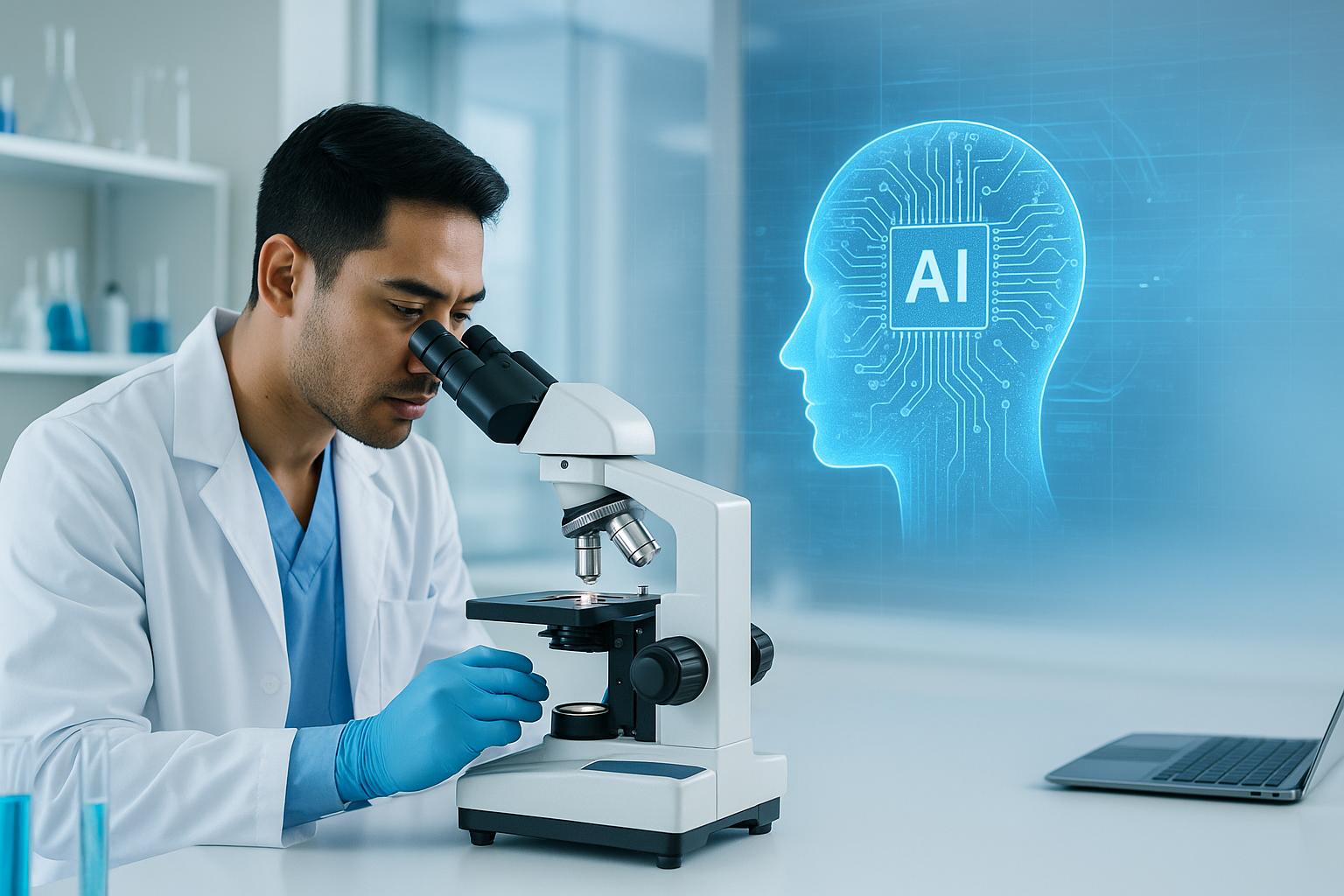
One minute you’re running QC and chasing a missing sample tube like it owes you money, and the next minute someone on the internet is declaring, “AI will replace healthcare jobs.” Hay nako. As if the lab is just one giant robot pressing buttons and calling it a day.
If you work in the medical laboratory, you’ve probably asked this at least once — maybe during a toxic shift, maybe while staring at an analyzer error for the fifth time before lunch: Will AI replace Medical Laboratory Scientists?
Short answer? No, not the way people think.
Long answer? AI is absolutely changing the lab. It’s already here. But replacing the human brain, judgment, and quiet detective work of an MLS? That’s a different story.
“Technology evolves — but the heart behind the science remains human.”
The Lab Is Changing, and Grabe, It’s Fast
Let’s be honest: the laboratory is not what it used to be.
Modern labs are becoming these hybrid ecosystems where instruments talk to each other, analyzers self-calibrate, middleware flags critical values, and data travels faster than tsismis in a Filipino family group chat. Results move in real time. Screens light up. Alerts pop up. Machines do tasks that used to take us forever by hand.
And yes, artificial intelligence in healthcare is part of that shift.
AI-powered systems can now help detect blood cell abnormalities, interpret digital pathology images, identify patterns in biomarker trends, and support disease prediction. In some settings, machine learning tools can spot subtle changes that a tired human eye might miss after the tenth hour of duty. And if you’ve ever squinted at a slide under fluorescent lighting while your back slowly gave up on you, you know that sounds both impressive and slightly rude.
But here’s the part people skip: AI does not work in a vacuum.
It depends on quality specimens. It depends on properly maintained instruments. It depends on validated systems, correct calibration, good data input, and professionals who understand what the numbers actually mean. In short, it still depends on us.
AI Can Be Fast, But It Doesn’t Know the Whole Story
This is where the conversation gets interesting.
AI is very good at repetitive, rules-based, high-volume tasks. It can sort, scan, flag, compare, and detect patterns at a speed no human can match. That’s not an insult. That’s just reality. I also can’t compete with a centrifuge, and I’ve made peace with that.
But healthcare is not just pattern recognition. The laboratory is not just data production. A result without interpretation is just data.
“A result without interpretation is just data — and that’s where the MLS remains irreplaceable.”
An AI tool might flag an abnormal CBC differential. Great. But can it understand the pre-analytical issues behind that sample? Can it recognize that the specimen was clotted, hemolyzed, delayed, mislabeled, or collected from a line that probably should not have been used? Can it connect the result to the patient’s condition, history, medication, or collection circumstances the way a trained MLS can?
Not in the full human sense, no.
Because in the lab, context is everything. And context is messy. Human. Imperfect. Sometimes the machine gives you a number, but your experience tells you, “Hmm, something’s off here.” That little pause? That instinct? That critical thinking? Sulit ang years of training natin for exactly that.
What AI Can Do Well
- Automate repetitive tasks with speed and consistency
- Analyze large datasets faster than manual review
- Support image analysis in hematology, microbiology, and pathology
- Flag unusual patterns for further review
- Reduce some human error in standardized workflows
What AI Still Can’t Fully Replace
- Clinical judgment based on real-world lab context
- Troubleshooting when instruments, samples, or systems fail
- Ethical decision-making in patient-centered care
- Communication with clinicians and healthcare teams
- Responsibility and accountability for final laboratory quality
And let’s not forget one very practical thing: when the analyzer starts acting possessed at 2 a.m., AI is not the one opening the manual, checking controls, calling support, and trying not to cry beside the printer. That’s us. Petmalu, but also exhausting.
The Real Threat Isn’t AI — It’s Staying Unprepared
If I’m being honest, I don’t think the biggest danger is AI replacing med techs. I think the bigger risk is med techs refusing to adapt while the field evolves around them.
That’s the uncomfortable part.
Technology will keep moving whether we like it or not. Digital pathology will expand. Automation will become more common. Data systems will get smarter. Lab workflows will continue shifting toward integration, analytics, and decision support. The MLS role may not disappear, but it will change.
And honestly? It already has.
Today’s Medical Laboratory Scientist is not just a test performer. We are quality guardians, instrument troubleshooters, data interpreters, patient safety advocates, and behind-the-scenes collaborators in diagnosis. Tomorrow’s MLS will need even more: digital literacy, informatics awareness, validation skills, and the ability to work alongside AI tools instead of fearing them.
The future belongs not to the professionals who compete with technology, but to those who learn how to use it wisely.
Have you noticed this in your own lab? More automation, more software, more pressure to understand systems beyond bench work? Kayo, ano sa tingin nyo — exciting ba or medyo nakaka-stress?
Why Human Judgment Still Matters in Patient Care
This is the part I never want people to forget.
Inside the lab, we may not always meet the patient. We may know them only through a barcode, a tube, a slide, a culture plate, a panic value. But every specimen belongs to a real person with a real story. Someone waiting for answers. Someone scared. Someone hoping the result explains why they’ve been feeling awful for weeks.
AI can process information. It cannot care.
And before anyone says, “Care doesn’t matter if the result is accurate,” let me stop you there. Care matters because care is what drives caution. It’s what makes an MLS double-check a strange value, question a mismatch, repeat a test, review a smear, or escalate a concern instead of blindly releasing a result.
That sense of responsibility is deeply human.
I’ve always believed that some of the most important work in healthcare happens quietly. No applause. No dramatic soundtrack. Just professionals doing careful, disciplined work because patients deserve truth, not guesswork. The lab is full of those people.
So no, I don’t think AI erases the value of Medical Laboratory Scientists. If anything, it highlights how valuable we are when the work becomes more complex.
How Med Techs Can Stay Relevant in the Age of AI
Now for the practical part, because inspiration is nice but bills and careers are real.
If you’re an MLS, MLT, or med tech student wondering how to future-proof yourself, here are a few things worth focusing on:
- Learn the technology, not just the test. Understand how analyzers, middleware, LIS, and digital systems work.
- Build strong troubleshooting skills. Machines fail. People who can solve problems will always be needed.
- Stay updated on AI in healthcare and laboratory automation. You don’t need to become a programmer, but you do need awareness.
- Strengthen your critical thinking. Question results. Review patterns. Understand limitations.
- Invest in continuing education. Certifications, webinars, workshops — boring sometimes, yes, but very worth it.
- Improve communication skills. Explaining lab issues clearly to colleagues and clinicians is a superpower.
In short: don’t compete with AI at being a machine. Be excellent at being human.
So, Will AI Replace Medical Laboratory Scientists?
My honest answer? AI will replace some tasks, reshape many workflows, and raise the standard for the profession — but it will not replace the full role of a skilled Medical Laboratory Scientist.
At least not in any meaningful, safe, patient-centered way.
The lab has always evolved. From manual methods to automation. From paper logs to digital systems. From microscope-heavy routines to data-driven workflows. Every generation of laboratorians has had to adjust. This is our version of that story.
And maybe that’s not something to fear. Maybe it’s a challenge.
A reminder that our value was never just in doing the task. Our value is in understanding the science, protecting the quality, and knowing when a result makes sense — or when it absolutely does not.
So if you’re worried about AI, I get it. Truly. Change is uncomfortable. Especially in healthcare, where the stakes are high and the burnout is real. But don’t underestimate what human expertise still brings to the bench.
Because behind every smart system still needs a smarter professional asking the right questions.
The future lab may be more automated, but it will still need humans who know when not to trust the machine.
If you’re a med tech, MLS, or healthcare worker, I’d love to hear your take. Is AI helping your lab, stressing you out, or both? Drop your thoughts in the comments — lalo na if you’ve seen automation change your day-to-day work. Let’s talk about it like the lab people we are: curious, slightly sleep-deprived, but still fighting for good science.